How to Create a Professional Invoice: A Practical Guide
Learn how to create a professional invoice with the right business details, itemized charges, tax, payment terms, and a final review checklist.
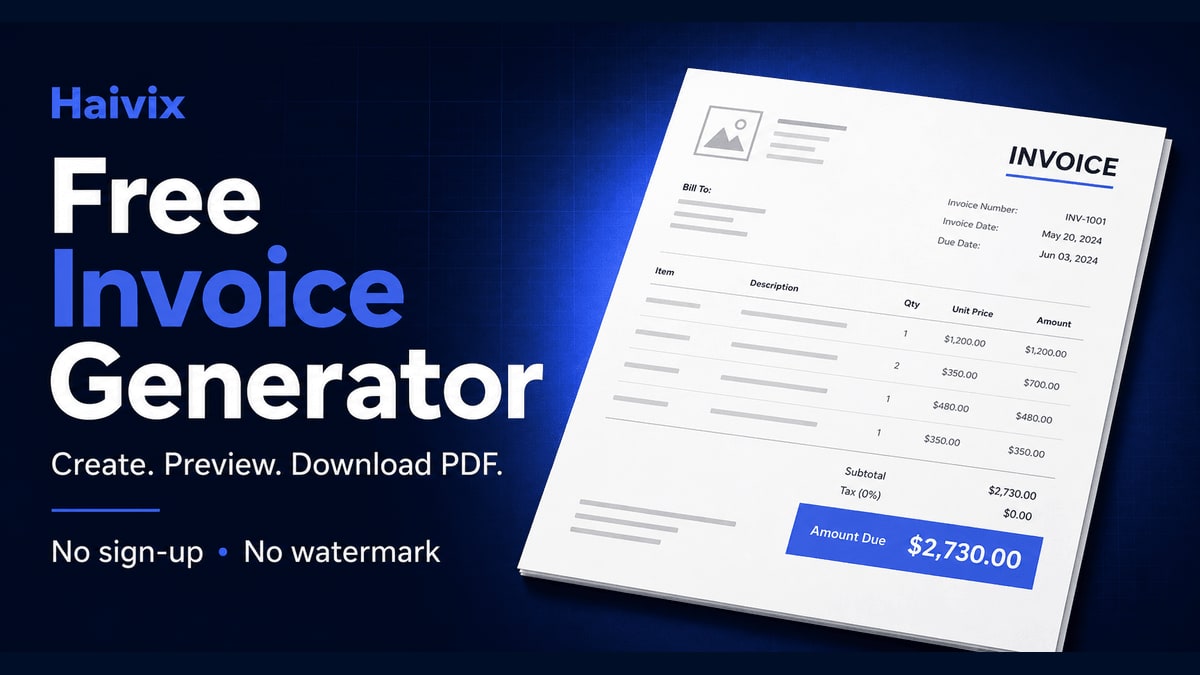
A professional invoice does more than request payment. It gives your client a clear record of who supplied the work, what was delivered, how the amount was calculated, when payment is due, and how to resolve a question. A consistent invoice also makes your own bookkeeping and follow-up easier.
The Haivix Invoice Generator brings the common fields into one browser-based workflow with a live preview and PDF download. No account is required, and the invoice details are processed locally in your browser.
Start with an identity the client can recognize
Put your legal business name or professional trading name at the top, followed by a reliable email address, phone number, and postal address. Add a logo when it helps the recipient connect the invoice with your proposal, contract, website, or previous correspondence.
The bill-to section should identify the customer responsible for payment. For a company, use the organization name and the relevant billing contact when you have it. Confirm the billing address and purchase-order reference before sending; large organizations may reject an otherwise correct invoice when their internal reference is missing.
Use a unique invoice number and unambiguous dates
Every invoice should have a unique reference. A simple sequence such as INV-2026-001 is easier to search, discuss, and reconcile than a generic filename. Keep the numbering method consistent, and do not reuse a number for a different transaction.
Show both the issue date and the due date. A phrase such as “Net 30” can be useful in the payment terms, but the actual calendar due date removes guesswork. Choose the correct currency explicitly, especially when you and the client operate in different countries.
Itemize the work so the total is easy to verify
Describe each product, service, milestone, or billable time category on a separate line. Add the quantity and rate so the line amount can be checked without asking you for a breakdown. Descriptions such as “Design work” are vague; “Homepage design and two revision rounds” gives the client a recognizable deliverable.
Use the same units as the agreement: hours, days, units, licenses, or fixed project milestones. Before adding tax or shipping, compare the subtotal with your approved quote, timesheet, or contract. For a quick cross-check of a percentage-based adjustment, use the Percentage Calculator.
Apply discounts and tax in a clear order
Show discounts as their own line instead of silently changing a rate. The Haivix generator applies a percentage discount to the subtotal, calculates tax on the discounted amount, and then adds any shipping or extra charge. That order is common, but your local rules or agreement may require a different treatment.
Label the tax in language the client expects, such as VAT, GST, or sales tax. Tax-registration numbers and jurisdiction-specific wording may also be required. An online invoice template can help with presentation and arithmetic, but it cannot determine the legal requirements for every country, state, industry, or business structure.
Write payment terms that answer practical questions
Useful payment terms say when the money is due, which payment methods you accept, which account or payment reference to use, and whether an agreed late fee or early-payment discount applies. Keep the wording direct and calm. If bank details are included, verify them carefully before every send.
A concise default might read: “Payment is due within 14 days by bank transfer. Please include the invoice number with your payment.” Add project-specific terms only when they reflect the signed agreement.
Review the PDF before sending
Do not rely on the total alone. Read the exported invoice as the client will see it and confirm the business name, client, invoice number, dates, currency, descriptions, quantities, rates, tax, payment instructions, and amount due.
- Make sure the invoice number has not already been used.
- Confirm the due date matches the agreed payment window.
- Check that the currency symbol and currency code are correct.
- Verify tax, discount, shipping, and the final amount due.
- Open the downloaded PDF and check that the logo and long text remain readable.
- Use PDF Compress only if a portal imposes a strict file-size limit, and keep the original invoice separately.
Create the invoice in your browser
Open the free online Invoice Generator, enter the business and client details, add the itemized charges, and review the live A4 preview. You can choose a currency, customize the accent color, add a logo, label tax for your region, and include notes and payment terms.
Download the PDF when it is ready, then store the final invoice according to your bookkeeping and retention requirements. The working draft stays in local browser storage on the current device until you clear it; it is not a cloud accounting record, delivery tracker, or automated payment reminder service.