Free PDF Tools: A Practical Privacy-First Guide
Learn how to merge, split, organize, compress, and convert PDFs with the right workflow and realistic privacy expectations.
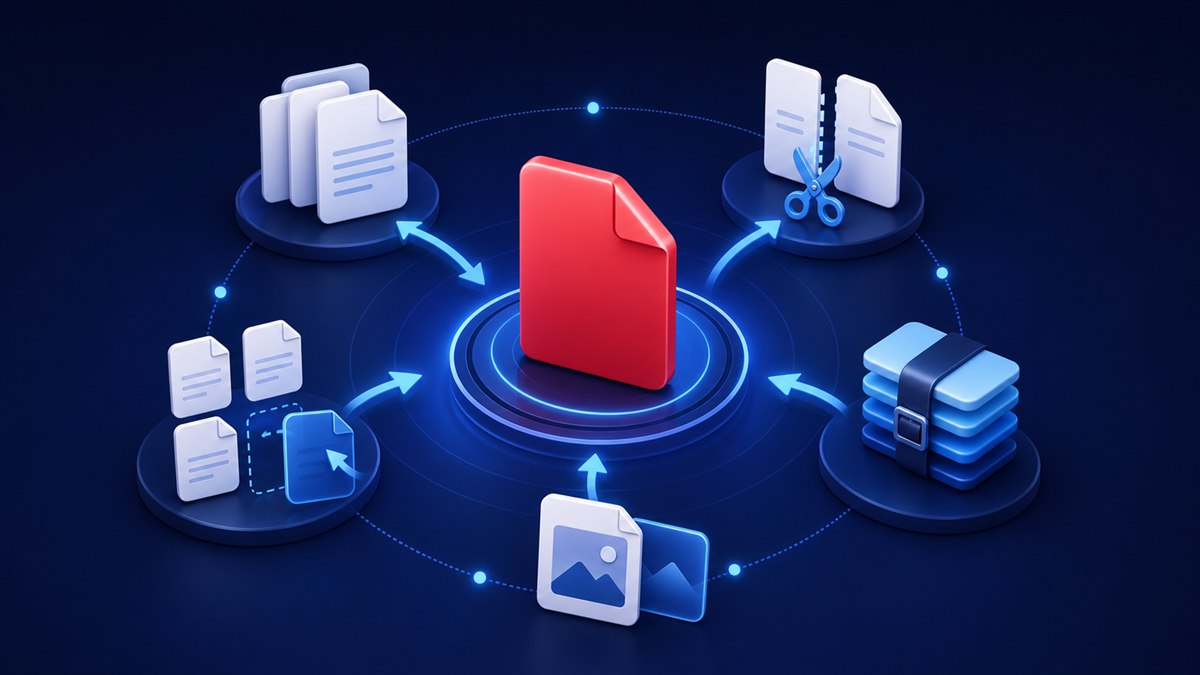
PDF work is rarely one operation. A typical handoff may require removing an unnecessary page, combining documents in the right order, reducing the result below an upload limit, and checking that the final file still looks correct.
The safest workflow is to start from copies, make one intentional change at a time, and inspect the output before deleting anything. Haivix provides focused tools so you can choose only the operation you need.
Merge files in the order people should read them
Use PDF Merge when several documents belong in one submission or handoff. Add the files, arrange them in the required order, create the combined document, and open the download to confirm the first and last pages.
Merging does not automatically reduce file size or repair inconsistent page dimensions. It also does not guarantee that advanced form behavior, bookmarks, or signatures will survive every transformation. Keep the originals until the recipient accepts the result.
Split or extract only what is needed
A long report may contain only a few pages relevant to a client, application, or review. Use PDF Split to separate ranges or Extract Pages when you need a specific subset.
Removing irrelevant pages can reduce accidental data sharing as well as file size. Review page thumbnails carefully, because printed page numbers and PDF page positions are not always the same.
Organize, rotate, and number pages
Scans and assembled documents often arrive in the wrong order or orientation. PDF Organize helps reorder pages, while rotate and page-number tools address presentation issues without rebuilding the whole file.
After rearranging pages, check references such as “see page 4,” table-of-contents entries, and section dividers. Visual order can change even when the text itself does not.
Compress with the content in mind
PDF size is often driven by high-resolution images and scans. PDF Compress can reduce those assets, but stronger compression may rasterize pages or soften detail. Choose the lightest mode that meets the upload requirement.
Inspect fine print, charts, signatures, and scanned text after compression. Keep the uncompressed original as the archival copy, especially when the document may need future editing or accessibility work.
Convert images and PDF pages deliberately
Use JPG to PDF to combine receipts, notes, or reference images into a simple document. Each image becomes a page; searchable text is not created automatically. Resize oversized phone photos first if the result becomes too large.
When exporting PDF pages to images, choose JPEG for photographic pages and PNG when sharp interface details or transparency matter. Conversion is useful for previews and sharing, but an image version will not preserve selectable text or interactive fields.
Understand browser-first privacy
Many Haivix PDF operations are designed to run in the browser, so the source file does not need to be uploaded to Haivix for the transformation. This reduces unnecessary transfer and is useful for routine local work.
Browser processing still uses the memory and storage of your device. Very large or complex PDFs may be slow, and sensitive documents should always be handled according to your organization's policy. If a page describes a remote service, read that notice before adding a file.
Final PDF checklist
- Work from copies and keep the original files.
- Confirm page order, orientation, and count.
- Open the downloaded result instead of trusting the file name alone.
- Check links, forms, signatures, small text, and image clarity when relevant.
- Verify the final size against the recipient's upload limit.
- Remove pages or metadata that should not be shared.